
Short summary
This page explains what the national framework is designed to do. It outlines how the framework supports consistent self evaluation by setting out key indicators, evidence expectations and an annual cycle of activity. It also introduces the wider context and culture needed for robust practice.
Key information
- The national self-evaluation framework sets out the indicators needed to understand performance.
- It explains the evidence required for rigorous and robust evaluation.
- It gives a rationale for how to deploy self-evaluation within an annual cycle.
- Existing approaches can be mapped to the framework.
- This page introduces how the framework operates in practice, the wider council context, culture requirements and the pilot activity
The National Framework: What it does
The National Framework does three things:
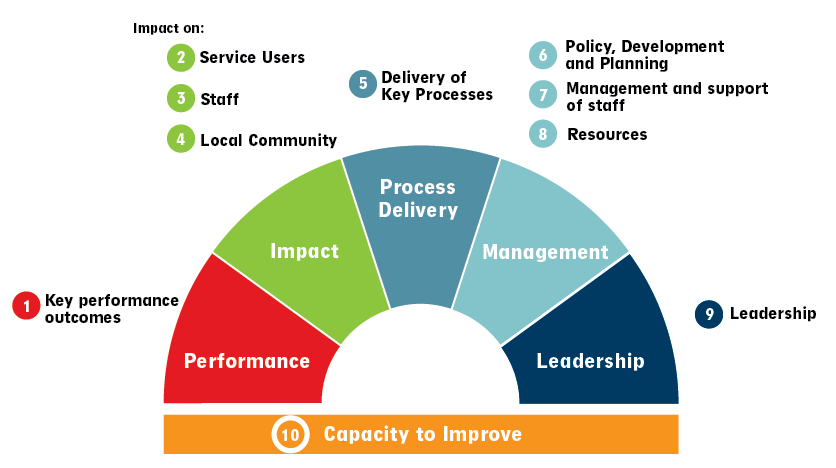
- Gives a clear framework of the indicators that are necessary to interrogate performance of council services whether for light touch or deeper thematic evaluation.
- Provides a baseline of the evidence and inquiry required across each indicator to demonstrate rigorous and robust evaluation.
- Specifies and provides rationale for how to deploy the framework within an annual cycle.
The framework can be mapped to approaches already in use. Councils do not need to replace existing methods. Instead, the framework helps elevate current practice and align it with a national standard.
This rest of this section looks at
- The annual cycle of self-evaluation between light touch and thematic activity
- The framework in the wider council context
- The culture required for robust self-evaluation
The National Framework in Action
When fully implemented, this National Approach ensures that checking how well the council is performing is systematic and built into regular processes. This requires;
- service areas to implement systematic self-evaluation so that they can feed evidence from their service to be considered together at council level.
- A regular schedule (or calendar) of what areas to undertake deeper evaluation should be created at the beginning of the year alongside how this will be done. This could also be risk-based, identifying areas that are a concern from normal performance reporting, risk assessment, or events in other local authorities or agencies. It could also be the focus of known and planned external quality assurance, such as a Best Value thematic audit.
For example, some areas may require a broader involvement of key colleagues, or need to be done when particular evidence is available e.g., financial performance or key performance indicators. The diagram below shows the flow of evidence from different types of self-evaluation activity, ultimately informing improvement priorities at both service and corporate level:
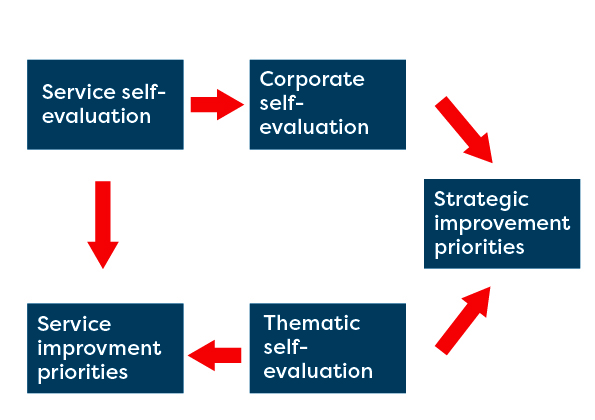
Using a single framework helps create a common language of quality and supports consistent comparison across the organisation. If we all use different frames of reference (or frameworks) then comparing and contrasting is more difficult, as is getting a council-wide self-evaluation.
The Framework
The framework connects methods already used in local government, so it should feel familiar. Its purpose is to help councils bring these existing approaches together and see how they align with national expectations.
Getting the Culture right for Rigorous and Robust Self-Evaluation
The aim is for the council to know itself, including strengths and weaknesses and the evidence behind them. Corporate self-evaluation is only accurate when it is based on robust and honest evaluation at service and thematic levels. Without this, corporate conclusions risk being bias and lacking rigour.
Self-evaluation should support the organisation and fit normal reporting timelines so that it is relevant to regulators and scrutiny bodies, and ideally would be accepted as consistent, rigorous and robust. It must also be honest, recognising weaknesses openly so that improvement can be supported. Organisational culture plays a key role. Staff will not identify issues if they fear penalty or sanction. High performing organisations know themselves well.
Self-evaluation can be done in a variety of ways. It should always be done for the benefit of the organisation first and fit in with normal reporting timelines, but it is also directly relevant to those who regulate or scrutinise quality. If self-evaluation undertaken by a council is considered consistent, rigorous and robust by those who scrutinise, then over time we would expect this to directly impact on their programme of scrutiny work.
It is also important that it is honest. It needs to recognise weaknesses as well as strengths openly and transparently so that action can be taken. However, this requires an organisational culture that supports this. Service areas will not openly identify issues and challenges if they believe that they may be penalised or sanctioned in some way as a result. Encouraging honesty, so that support can be provided to improve things, is essential and needs to be built into organisational culture from the top. High performing organisations know themselves well.
The Pilot
Phase 2 of the project focuses on testing the implementation of the framework in practice across a diverse range of local authorities by way of a pilot. The purpose is not only to assess feasibility, but to generate practical learning that can inform improvement during the life of the project and support national roll‑out.
The learning from this phase will be used to:
- Refine and strengthen the framework itself
- Develop practical resources and toolkits to support implementation
- Identify and address barriers to effective adoption
- Inform readiness for wider implementation across all authorities
To support this, Phase 2 will adopt an action research approach, enabling learning to be generated, shared and applied iteratively rather than retrospectively.
The four pilot councils are Angus; Argyll and Bute; Dumfries and Galloway and Glasgow