
Flow of evidence
Core approach
Councils recognise that achieving continuous improvement needs rigorous self-evaluation that leads to improvement, alongside proportionate external scrutiny for assurance and support. Internal self-evaluation must be consistent, honest and robust. It should be built into everyday practice and seen as a way to deliver high quality services.
A council wide approach to self-evaluation
Checking how well the council is performing should be systematic and built into regular processes. Service areas should do the same so that evidence can be considered together at council level. A regular schedule of what to evaluate should be set at the start of the year, including how it will be done. This can be risk based, for example triggered by performance reporting, risk assessment or events in other local authorities or agencies. For example, some areas may require a broader involvement of key colleagues, or need to be done when particular evidence is available e.g., financial performance or key performance indicators. The diagram below shows the flow of evidence from different types of self-evaluation activity, ultimately informing improvement priorities at both service and corporate level:
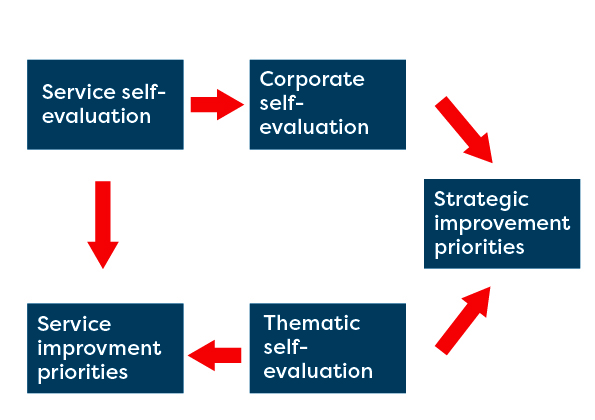
The intention is for the council to “know itself”, understanding its areas of strength and of weakness, and what evidence it has to underpin that assessment. Accurate corporate self-evaluation needs to be based on robust and honest self-evaluation at service level and thematic levels, otherwise there would be an insufficient evidence base to make a judgement at corporate level leading to a corporate evaluation being impressionistic and lacking rigour.
A culture of honesty
Self-evaluation can be done in a variety of ways. It should always be done for the benefit of the organisation first and fit in with normal reporting timelines, but it is also directly relevant to those who regulate or scrutinise quality. If self-evaluation undertaken by a council is considered consistent, rigorous and robust by those who scrutinise, then over time we would expect this to directly impact on their programme of scrutiny work.
It's also important to be honest about problems and weaknesses. Glossing over weak areas undermines what the organisation has said in all areas and scrutiny bodies can then feel inclined to delve deeper into all other areas to investigate. This forces scrutiny bodies in a position of looking for problems rather than evaluating what it sees.