
Short summary
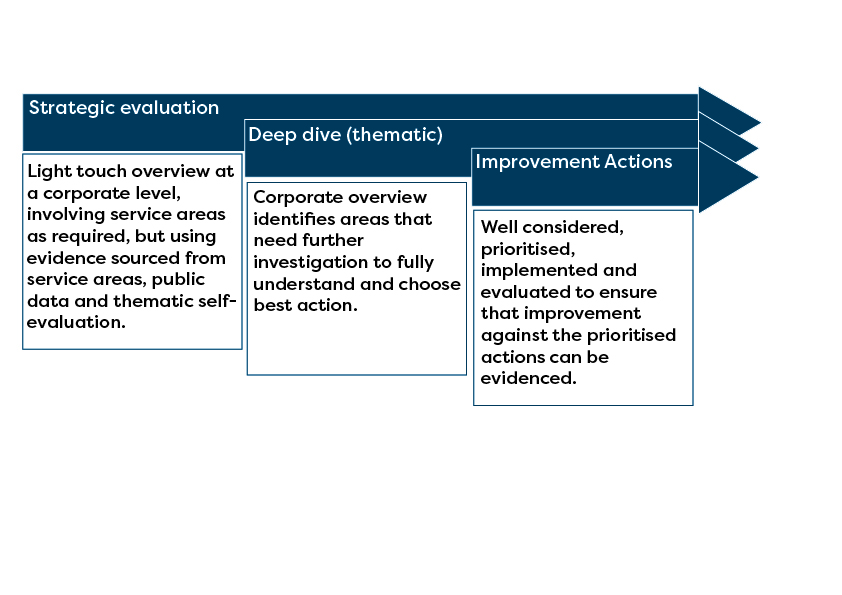
This page explains how to use the framework as part of day-to-day self-evaluation. It covers how to apply the framework through evidence gathering, reflective questioning, deep dive evaluations and improvement action tracking. It also introduces the flow of work from strategic evaluation to prioritised actions.
Key information
- The framework provides a strategic overview to challenge
- Senior leadership should consider key areas of the framework throughout the year.
- Strategic evaluation can be done as a full review every three years or through a rolling programme.
- Evidence from service level scrutiny, regulators and government returns should map to the framework.
- Reflective questions support discussion and curiosity. They are not a checklist.
- Deep dives help councils understand issues that need further investigation.
- Improvement actions should be identified, scoped, implemented and evaluated. Externality can help reduce groupthink.
Applying the framework
The framework provides a strategic overview of many important areas. Senior leadership should use the framework during the year to interrogate and challenge assumptions and the evidence they receive. This can help identify areas needing immediate action or further examination.
A comprehensive strategic self-evaluation could be done every three years, or a rolling programme could be used instead. The intention is not to repeat full self-evaluation each time, but to do enough to identify areas that would benefit from further attention. Such areas could also be derived from national data such as the Local Government Benchmarking Framework, or an incident in another similar authority that raises questions for the senior team