
Short summary
This page introduces the overall self-evaluation framework. It explains how the framework is structured, how it links to existing approaches and why using a single framework supports consistency across services. It also sets out how scrutiny bodies view self evaluation. [See About section]
Key information
- The framework is divided into self evaluation areas, each with sources of evidence and reflective questions.
- The Public Service Improvement Framework (PSIF) is one method to conduct evaluation against the framework. [See About section]
- It supports diagnosis of issues by linking performance, impact, process and leadership.
- A single structure helps simplify reporting and align existing approaches. [See About section]
- Scrutiny bodies expect evaluation to lead to improvement and be part of everyday practice.
The Overall Self-Evaluation Framework
The overall framework is broken down by self-evaluation area e.g. Leadership. Click on any particular self-evaluation area to see potential sources of evidence and reflective questions to help you to conduct a self-evaluation.
The Improvement Service PSIF is a method to support local authorities to conduct a self-evaluation against the framework.
It is up to each local authority to decide how to use the framework, but it is not a requirement to do a deep dive on each self-evaluation area each year. Clear linkages between the areas means that the framework supports diagnosis, for example by helping determine where an issue relates to outcomes, partnerships, clarity of policy, staff capability or leadership.
Using the framework to structure evidence makes the corporate overview clearer and helps to identify where a deep dive would be useful.
The Framework
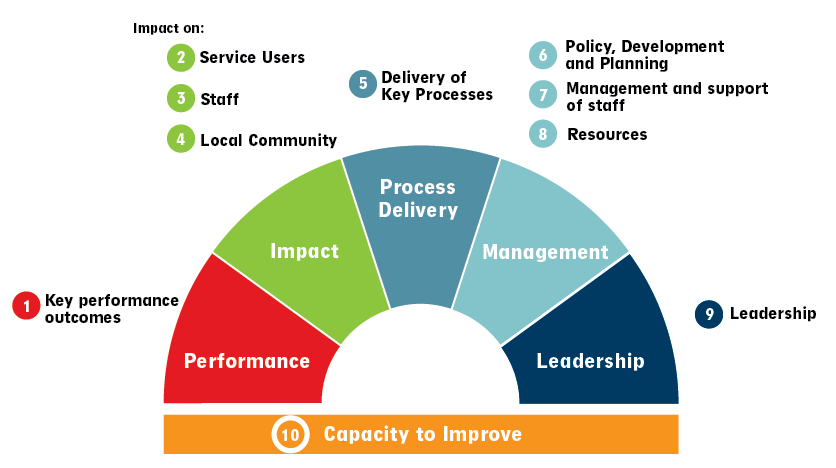
The framework consists of 10 sections, listed below and linked to the corresponding Framework page:
4. Impact on the local community
6. Policy development and planning
7. Management and support of staff
8. Resources
9. Leadership
The relationship to other things
This approach integrates with everything else that a local authority uses to plan, deliver and monitor its work. For example:
- A council Delivery Plan would relate to 1.1 and 6.2 above
- The Community Plan relates to 1.1, 5.2 and 8,1 above
- The Local Government Benchmarking Framework allows performance to be compared under 1.1, and also contributes to other areas above.
- Regular key performance indicator (KPI) reporting
Including national support such as:
- Public Service Improvement Framework (Improvement Service)
- Improvement Service Peer Collaborative Improvement
- How good is our school? (HMIE)
Simpler is better. Lots of key performance indicators, service standards, separate external requirements, multiple reporting can make it difficult to focus on things that really matter, and makes staff less likely to feel positively about the process.
Why a single framework?
Having a single framework or structure to conduct self-evaluation across all council areas has many potential benefits:
- Development of a common language across services
- The ability to more easily aggregate information on the same issue across council services
- Ensuring that the same breadth of scope is used across service areas i.e. not just focusing on external requirements for reporting
- Integration of existing external regulatory and/or reporting requirements
- Helps everyone understand what continuous improvement is and their role in it
The council-wide framework is necessarily high level. More specific self-evaluation frameworks could be nested below this, using the same structure – at service level, and where appropriate, at team level. An example could look like this:
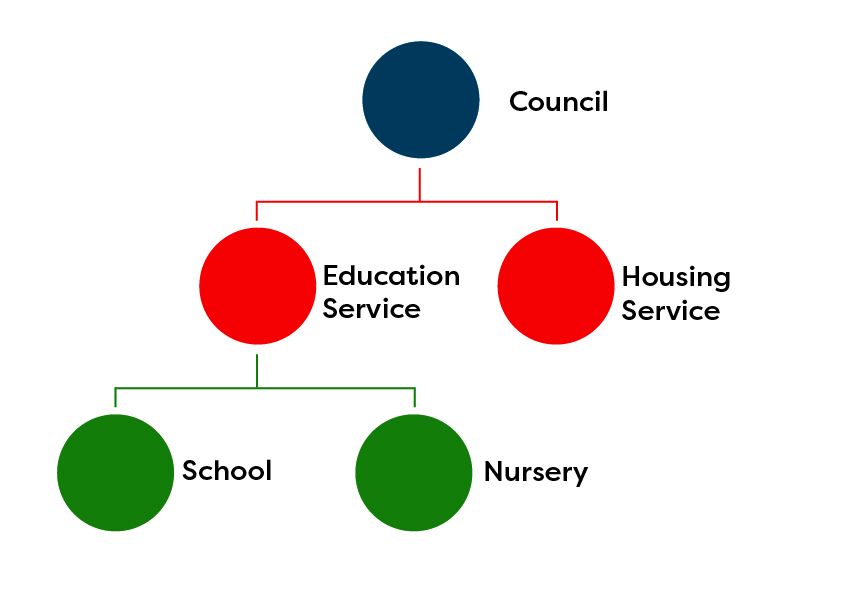
In this example, the Education Service has a framework of its own, structured in the same way as the council framework. Below that there exists school self-evaluation frameworks and a different framework for Early Learning and Childcare. However, the Housing Service only needs a self-evaluation framework at service-level. The decision is down to the nature of the service and the existence of frameworks used by external scrutiny bodies. Some service areas already work to such frameworks. Others might simply need to consider how to report their performance in a way that is easily aggregated under the headings.
It is not a requirement that all service areas develop a self-evaluation framework under this structure, although for some it may be the best approach to clarify expectations and secure buy-in. However, existing reporting requirements should be aligned with this framework.
Why this framework?
This framework builds on existing self-evaluation methods and aims to connect methods already in use. By all councils using the framework, the local government sector can have consistent standards, better evidence from data, and visible assurance for partners and communities. Councils and partners all want to tell a clearer story of local government improvement: sector led, proportionate and credible.
What scrutiny bodies are expecting
Scrutiny bodies are focused on the impact of self-evaluation activity and the improvement of outcomes. They do not mandate what processes are used to conduct self-evaluation, only that those are owned by the organisation and lead to improvement.
The processes outlined in this document are designed to help local authorities develop robust and rigorous self-evaluation and secure improvement across all of their service areas. The success of this approach will only be realised if councils embed this into their everyday practice and commit to responding to the results.
If the processes are not consistently embedded, improvement will be undermined and questioned by scrutiny bodies. What matters most is the impact of self-evaluation on outcomes.
Related resources